Feb 2, 2026
How Serious Kitchens Think About Water
How Serious Kitchens Think About Water
Every professional kitchen has a point of view on ingredients. The provenance of proteins, the quality of olive oil, the grade of flour — these decisions are made deliberately, documented, and defended. Water is the one ingredient that moves through every preparation, every day, and is almost never treated with the same consideration. At the highest level of cooking, that has started to change.
The Ingredient That's Always There
Water is present in every stock, every sauce, every dough, every braise, and every beverage served in a professional kitchen. It is the medium through which flavor compounds are extracted, the environment in which yeast ferments, the solvent in which proteins unfold and starches gelatinize. Its mineral composition, pH, temperature, and purity are variables — and like any variable in a serious kitchen, they produce different outcomes depending on how they are managed.
The research on what those outcomes look like is specific and well-documented.
What Water Does to Coffee
The Specialty Coffee Association has established water quality standards that function as the global benchmark for professional coffee and espresso service. The standards specify a TDS of 75 to 250 parts per million, calcium hardness of 50 to 175 parts per million, alkalinity of 40 to 70 parts per million, and pH close to 7.¹ Water outside these ranges produces under- or over-extraction, muted acidity, excessive bitterness, or premature equipment scaling.¹
The chemistry behind these standards is documented. Computational modeling of how water minerals interact with coffee compounds shows that magnesium ions exhibit higher binding energies than calcium to key acidic and aromatic molecules — predicting higher extraction yields and more intense flavor when magnesium is present at moderate concentrations.² The mineral composition of brewing water is not an aesthetic preference. It is an extraction variable with measurable flavor consequences.
What Water Does to Bread
In bread baking, water is the medium through which yeast ferments and gluten forms. Mineral content affects both. Technical guidance from King Arthur Baking and allied culinary institutions recommends water hardness of approximately 100 to 150 parts per million for professional bread production — sufficient mineral content to support yeast nutrition and strengthen gluten networks, without the excess hardness that tightens gluten and slows fermentation.³
Research on sourdough specifically found that residual chlorine in water increased markers associated with altered microbial activity and compromised starch-gluten network integrity — with hypochlorite shown to cleave glycosidic bonds in starch and reduce gluten's cohesion.⁴ Water that has not had its disinfectant content addressed is changing the structure of the bread before it reaches the oven.
What Water Does to Pasta
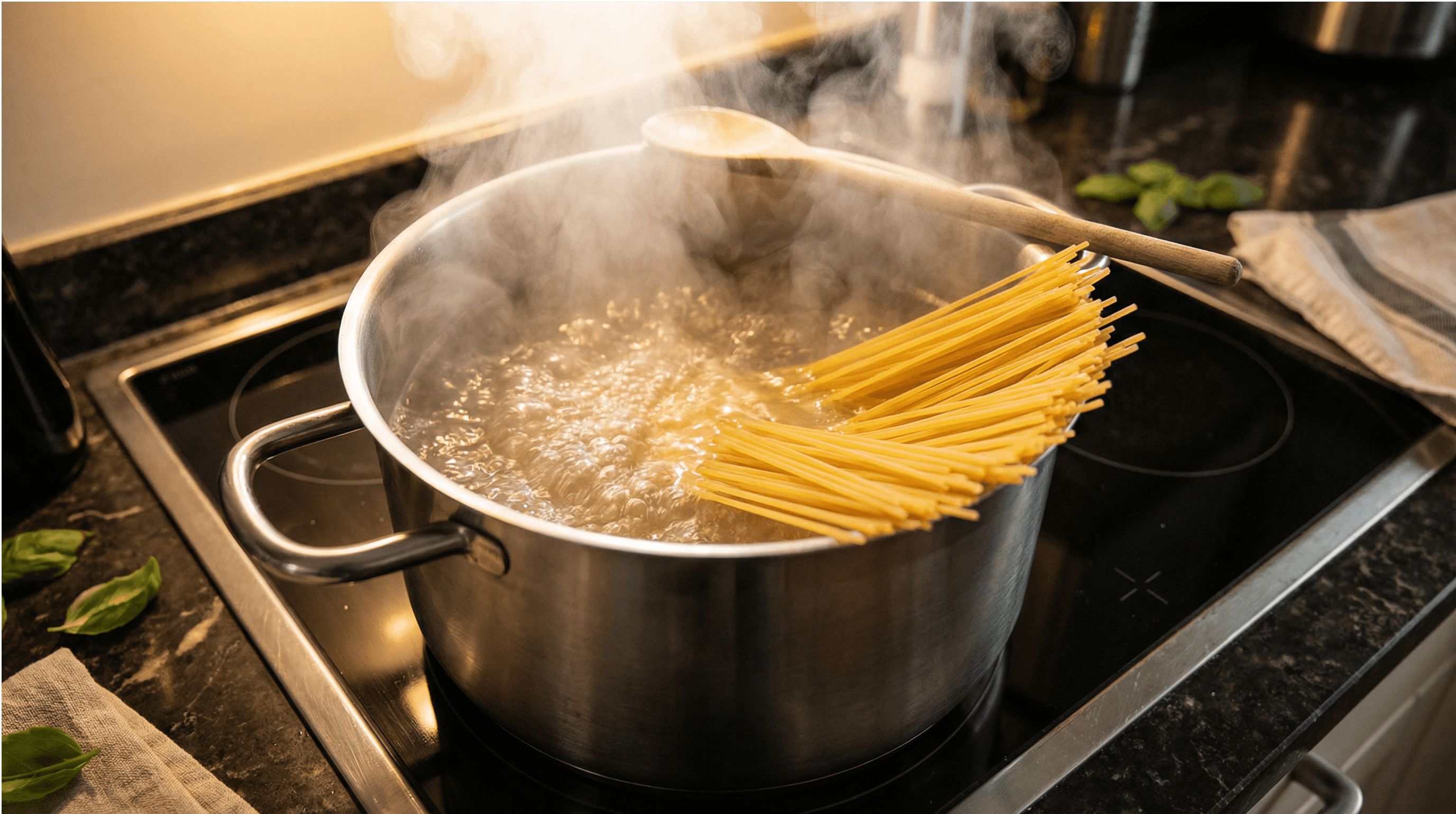
A foundational cereal chemistry study on spaghetti cooking found that water hardness — specifically the concentration of calcium and magnesium ions — significantly affected cooked pasta stickiness and cooking loss.⁵ Distilled or very soft water produced softer, more fragile strands with higher surface sloughing. Higher mineral content produced firmer texture with lower cooking loss when divalent cation concentrations were within an optimal range.⁵
Follow-up research confirmed that changes in cooking water mineral load alter pasta firmness, stickiness, and surface quality — linking the ionic composition of the water directly to the texture of the finished dish.⁶
What Water Does to Stocks and Broths
A controlled study on soup preparation compared three cooking waters with distinct mineral profiles against ultrapure low-mineral water under otherwise identical conditions.⁷ The results were measurable and significant. Mineral-rich water increased the concentration of key taste nucleotides — the compounds responsible for savory depth — and altered the profiles of free amino acids and volatile aroma compounds. Ultrapure water produced soups with the lowest levels of flavor nucleotides and higher concentrations of certain breakdown products, resulting in detectably different sensory profiles.⁷
The water was the only variable. The flavor outcomes were different.
The Standard Professional Kitchens Are Moving Toward
The SCA's water standards are not a niche concern among coffee specialists. They represent a formalized recognition that water composition is an operational parameter in beverage quality — one that many high-end cafe and restaurant programs now address through filtration and remineralization systems specifically designed to meet or approximate those specifications.⁸
The same logic that drives water management in professional coffee programs applies across the kitchen. pH affects vegetable color retention through its interaction with chlorophyll and pectin chemistry.⁹ Water temperature at dough mixing is a formal control variable in professional baking, with target temperatures derived precisely because fermentation rate and gluten development are sensitive to it.¹⁰ Water is not a passive background element in serious cooking. It is an ingredient with properties — and those properties shape the outcome of everything made with it.
At the highest level of cooking, water is not a utility. It is an ingredient — one that shapes extraction, texture, and the quality of everything made with it.
Sources
Third Wave Water / Specialty Coffee Association — SCA Brewing Water Standards
ACS Publications / Journal of Agricultural and Food Chemistry — Magnesium, Calcium, and Coffee Extraction (2014)
King Arthur Baking — Water Hardness and Bread Baking Reference
PMC / National Library of Medicine — Chlorinated Water and Sourdough Chemistry (PMC11537093)
Cereal Chemistry / Cereals & Grains Association — Effects of Cooking Water on Spaghetti Quality (Malcolmson & Matsuo, 1993)
Wiley / Journal of the Science of Food and Agriculture — Pasta Quality and Cooking Water Mineral Load
PMC / National Library of Medicine — Water Mineral Composition and Mutton Soup Flavor (PMC8565249)
Daily Rise Coffee / SCA — SCA Brewing Standards in Professional Practice
FAO — Nutrient Losses and Gains in Vegetable Cooking
Agriculture Institute — Importance of Water Quality in Bread Making